Salt-Based Softeners vs Salt-Free Conditioners Explained
Salt-based softeners remove hardness minerals; salt-free conditioners only stop them from sticking. Here is how each performs on Queen Creek's 15-25 grain water.
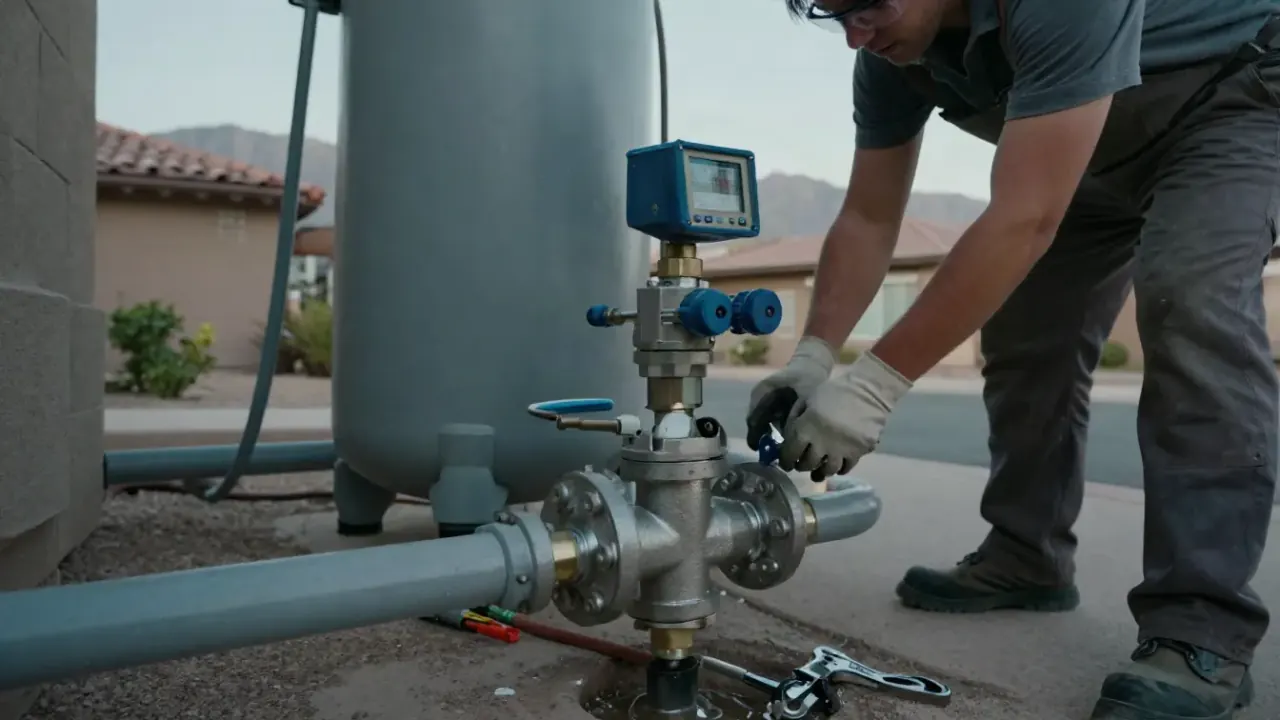
A salt-based softener removes calcium and magnesium from your water through ion exchange, while a salt-free conditioner leaves those minerals in the water and only changes their structure so they are less likely to stick to pipes and fixtures. That single difference drives everything else: the cost, the maintenance, the feel of the water, and whether your water heater survives another Arizona summer.
Queen Creek sits on some of the hardest municipal water in the East Valley, so the choice between these two systems is not academic. We install and service both types across the area, and we have watched homeowners waste $1,500 on the wrong unit more than once. This guide breaks down how each system actually performs on local water, what they cost in 2026, and which one fits your house.
The Core Difference: Removal vs. Suspension
Salt-based softeners vs salt-free conditioners comes down to one question: do you want the hardness minerals gone, or do you just want them to behave? A salt-based system physically strips calcium and magnesium out of the water and replaces them with sodium or potassium ions. A salt-free conditioner, sometimes called a saltless water softener, runs water past a media tank that uses template-assisted crystallization (TAC) to convert dissolved minerals into microscopic crystals that stay suspended instead of clinging to surfaces.
The practical result is that softened water lathers differently, rinses cleaner, and leaves no white scale on shower glass. Conditioned water still contains the same 15 to 25 grains per gallon of hardness that came in from the tap, and it still tastes like Queen Creek water. It just does not build up on your fixtures the way untreated water does.
If you want the full picture on how a no-salt system works in practice, our page on Salt-Free Water Conditioners Queen Creek AZ walks through the media life and flow rates. If you want minerals gone entirely, you are looking at a traditional ion-exchange unit.
How Hard Is Queen Creek Water?
Queen Creek water hardness runs between 15 and 25 grains per gallon, depending on which well field or delivery zone feeds your subdivision. For reference, the Water Quality Association classifies anything above 10.5 grains per gallon as very hard. We are well past that.
That number matters because salt-free conditioners have a practical ceiling. Most TAC media is rated for water up to about 25 grains per gallon, and performance drops as hardness climbs. At 22 grains, a conditioner is working near its limit. At 8 grains, it would be a perfectly reasonable choice. Queen Creek is not an 8-grain town.
You can verify your exact number before you spend a dollar. We run a Water Hardness Testing Queen Creek AZ service that gives you a grains-per-gallon reading, plus iron and manganese levels, in about 20 minutes. Iron matters more than most people realize: anything above 0.3 ppm will foul salt-free media faster than hardness will.
Salt-Based Softener Pros and Cons
A salt-based softener is the only technology that actually removes hardness from Queen Creek water, and that is why roughly 8 out of 10 homes we service run one. The pros are concrete:
- Zero scale on water heater elements, which extends tank life from roughly 8 years to 12 or more in our climate.
- Soap and detergent use drops 50 to 70 percent because there is nothing left for them to fight.
- Dishes come out spot-free without rinse aid, and shower glass stays clear for weeks.
- Works at any hardness level, including the 25-grain water at the top end of Queen Creek's range.
The cons are equally real. You buy 40-pound bags of salt, usually 8 to 12 per year for a family of four, at $7 to $10 per bag. You have a brine tank to keep filled. And you add a small amount of sodium to your drinking water, roughly 20 to 30 mg per 8-ounce glass, which matters if you are on a sodium-restricted diet.
For most Queen Creek households, the trade is straightforward: 30 minutes of maintenance per month in exchange for appliances that last longer and a house that cleans easier. If you are weighing the full Water Softener Queen Creek AZ decision for the first time, that maintenance load is the single biggest factor people underestimate.
Salt-Free Conditioner Pros and Cons
A salt-free conditioner's biggest advantage is that you never touch a salt bag. There is no brine tank, no backwash cycle, no drain line, and no sodium added to your water. For snowbirds who leave for four months, or for anyone on a low-sodium diet, that is a genuine benefit.
The system also uses no electricity in most configurations, and the media typically lasts 5 to 7 years before replacement. Installation is simpler because there is no drain connection required.
The cons start with performance. Salt-free conditioners do not remove hardness, so your water heater still accumulates scale, just more slowly. They do not soften the water in the traditional sense, so soap lather will not improve. And in Queen Creek's 20-plus grain water, we have seen media exhaust in as little as 3 years instead of the rated 5 to 7.
They also cost more upfront than most people expect. A quality TAC unit runs $1,200 to $2,200 installed, which is close to what a comparable salt-based softener costs. You are paying similar money for less capability, and the only thing you get back is convenience.
Salt-Based vs Salt-Free Softener Costs in Queen Creek
Typical 2026 pricing in the Queen Creek area breaks down like this for a 3-bedroom home with 4 people:
- Salt-based softener: $1,400 to $2,600 installed, plus $70 to $120 per year in salt.
- Salt-free conditioner: $1,200 to $2,200 installed, plus $0 in salt, but $400 to $700 for media replacement every 3 to 7 years.
- Water heater replacement (scale-related): $1,800 to $2,800, which is the cost you avoid with proper softening.
Over a 10-year window, a salt-based system costs roughly $2,300 to $3,800 all-in. A salt-free system costs roughly $1,900 to $3,600 once you factor one or two media changes. The numbers are closer than the marketing on either side suggests.
The difference shows up in your appliances. A tankless water heater in Queen Creek without softening will scale up in 3 to 5 years and lose efficiency the whole time. With a salt-based softener, that same unit runs 15 to 20 years. That is where the real money lives, and it is why we push homeowners toward a Scale Protection for Water Heaters and Fixtures Queen Creek AZ plan alongside whichever system they choose.
Maintenance: Salt-Based Softener vs Salt-Free in Queen Creek
Salt-based softener maintenance vs salt-free in Queen Creek is not a fair fight on paper, but it is closer in practice than the brochures claim. Here is what each actually requires:
- Salt-based: Add salt every 4 to 6 weeks. Clean the brine tank once a year. Replace resin every 10 to 15 years. Test hardness annually.
- Salt-free: Replace media every 3 to 7 years. Flush the tank if iron is present. Test hardness annually to confirm nothing changed.
That brine tank cleaning is the task most homeowners skip, and it is the one that causes the most service calls. Salt bridges, salt mushing, and iron sludge all start in a neglected tank. Our Brine Tank Cleaning Queen Creek AZ service handles it in under an hour, and it prevents the $300 to $500 control valve failures that follow a bridged tank.
Salt-free systems have their own failure mode: media channeling. If the tank is undersized for your flow rate, water finds a path through the media and stops contacting it. You will not notice until your fixtures start spotting again, usually 2 to 3 years in.
Which Is Better for Queen Creek Homes?
For Queen Creek homes on 15-plus grain water, a salt-based softener is the better choice in almost every case. It is the only option that removes hardness, it protects water heaters and appliances more effectively, and the maintenance is predictable.
Salt-free conditioners make sense in three specific situations: you are on a sodium-restricted diet and do not want to add a reverse osmosis system, you leave the house vacant for months at a time, or your hardness tests below 12 grains per gallon. Outside those cases, you are paying softener money for conditioner results.
We install both types across the East Valley, and the pattern holds neighborhood to neighborhood. In the newer builds around Water Softener in Hastings Farms, where homes went up in the last 8 years with PEX plumbing and tankless heaters, salt-based systems dominate because the appliance stakes are higher. In the 55-plus communities, we see more salt-free interest because of the low-sodium angle, and we usually pair those with a Reverse Osmosis Systems Queen Creek AZ unit at the kitchen sink for drinking water.
What to Watch Out For
The biggest mistake we see is buying a salt-free conditioner to solve a scale problem that only ion exchange can fix. If your water heater is already popping and your shower head is clogged, a conditioner will not reverse that. It might slow it down. It will not clean it up.
Second mistake: sizing by bedroom count instead of flow rate. A 4-bedroom home with 3 bathrooms and a tankless heater needs a 48,000-grain unit, not the 32,000-grain unit the big-box store sells. Undersized softeners regenerate too often, burn through salt, and leave you with hard water at the tap.
Third: ignoring iron. Queen Creek water occasionally tests above 0.3 ppm iron, and iron destroys both resin and TAC media. Test for it before you buy anything. If iron is high, you need pretreatment regardless of which system you choose.
Fourth: skipping the drain. A salt-based softener needs a drain line within 20 feet, and it needs to discharge somewhere legal. We see DIY installs dumping into laundry standpipes that back up during regeneration. That is a $150 fix if you catch it early and a $2,000 floor repair if you do not.
When to Call a Professional
Call us when you are not sure which system fits your water, when your current softener is not keeping up, or when you are buying a new house and want the plumbing checked before you commit. We test hardness and iron on site, size the unit to your actual flow rate, and install it so it drains correctly the first time.
We also handle the jobs most homeowners do not want to touch: Softener Valve and Control Head Repair Queen Creek AZ when a unit stops regenerating, and full Softener Removal and Replacement Queen Creek AZ when an old unit is limping along and costing more to fix than to swap. If your system is 12 years or older and you are replacing resin anyway, replacement usually wins on math.
Frequently Asked Questions
What is the difference between salt-based and salt-free softeners?
Salt-based softeners remove calcium and magnesium through ion exchange and add a small amount of sodium. Salt-free conditioners leave the minerals in the water and use TAC media to keep them from sticking to pipes. Only salt-based systems actually soften water in the technical sense.
Which is better, salt-based or salt-free, in Queen Creek AZ?
Salt-based wins for most Queen Creek homes because local water runs 15 to 25 grains per gallon. Salt-free media is rated to about 25 grains and performs poorly at the top of that range. Choose salt-free only if you are on a low-sodium diet or leave the home vacant for months.
Do salt-free conditioners really work in Queen Creek, Arizona?
They reduce scale buildup but do not eliminate it. On 20-grain Queen Creek water, expect media to last 3 to 5 years instead of the rated 5 to 7, and expect your water heater to still accumulate some scale. They work best below 12 grains per gallon.
Is a salt-based softener worth it in Queen Creek?
Yes, for most households. A $1,400 to $2,600 install protects a $1,800 to $2,800 water heater, cuts soap use by 50 to 70 percent, and eliminates scale on fixtures. The $70 to $120 annual salt cost is the trade-off.
Can I use a salt-free conditioner with hard water in Queen Creek?
You can, but performance drops as hardness rises. Above 20 grains per gallon, we recommend a salt-based softener instead, or a salt-free unit paired with pretreatment if iron is present. Test your water first to know which side of that line you are on.
Get Help With Water Softener in Queen Creek
If you are still deciding between salt-based and salt-free for your Queen Creek home, we will test your water, size the right system, and install it so it works from day one. Call Queen Creek Water Softener at (480) 337-3003 and we will get you a straight answer on what your water actually needs.